
We went back through 1,335 of our own home inspection reports from across the Kansas City area, on both sides of the state line, and counted how often each problem showed up. Here’s what we find most, how it changes from one part of the metro to the next, and what it means if you’re buying.
Data through October 21, 2026, from 1,335 Inspect KC inspections.
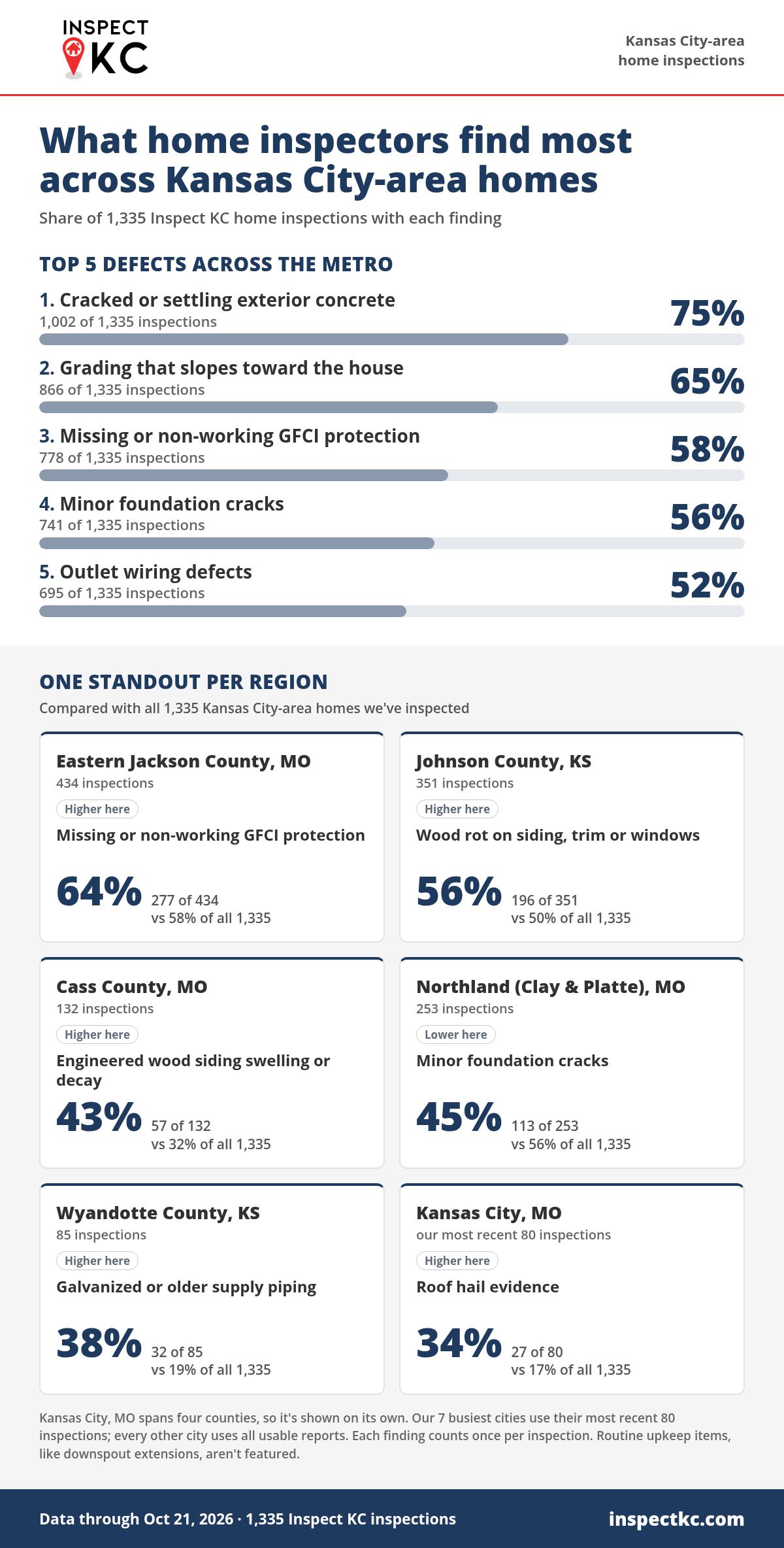
The 5 defects we find most in Kansas City-area homes
- Cracked or settling exterior concrete: 1,002 of 1,335 (75%). Driveways, walks, patios and steps that have cracked, sunk or washed out underneath. Most of it is cosmetic. It matters when the slab tips water back toward the house or leaves a trip edge.
- Grading that slopes toward the house: 866 of 1,335 (65%). Soil that’s flat or slopes in, so rain runs toward the foundation instead of away from it.
- Missing or non-working GFCI protection: 778 of 1,335 (58%). Outlets in kitchens, baths, garages, basements and outside that don’t have shock protection, or a GFCI that doesn’t trip when we test it.
- Minor foundation cracks: 741 of 1,335 (56%). Small cracks in basement walls or slabs that haven’t shifted out of line. Most are from shrinkage or normal settling. We note them so you know what to keep an eye on.
- Outlet wiring defects: 695 of 1,335 (52%). Open grounds, reversed polarity, loose outlets or dead outlets. Most are quick fixes for an electrician, but they’re worth fixing because they affect shock protection.
Grading is the one most tied to water. When soil slopes toward the house, rain ends up against the foundation, and a lot of the basement trouble we see starts there. Just behind the top 5: worn or damaged shingles at 691 of 1,335 (52%) and wood rot on siding, trim or windows at 668 of 1,335 (50%).
We left simple upkeep items off this list. The biggest one is downspouts emptying next to the foundation, in 888 of 1,335 (67%) inspections. Extensions are cheap, and they’re one of the easiest ways to keep water away from a basement.
How the regions compare
We grouped the cities we’ve inspected into five nearby regions. Kansas City, Missouri stretches across four counties, so we keep it on its own and compare it with all 1,335 homes. Each number is the share of inspections in that area with the finding.
| Finding | All homes 1,335 inspections | Eastern Jackson County 434 inspections | Johnson County, KS 351 inspections | Northland 253 inspections | Cass County, MO 132 inspections | Wyandotte County, KS 85 inspections | Kansas City, MO* 80 inspections |
|---|---|---|---|---|---|---|---|
| Cracked or settling exterior concrete | 75% | 80% | 73% | 63% | 77% | 80% | 85% |
| Grading that slopes toward the house | 65% | 69% | 63% | 59% | 70% | 61% | 65% |
| Missing or non-working GFCI protection | 58% | 64% | 60% | 45% | 55% | 62% | 65% |
| Minor foundation cracks | 56% | 59% | 60% | 45% | 61% | 51% | 48% |
| Outlet wiring defects | 52% | 54% | 52% | 48% | 45% | 68% | 49% |
| Prior foundation repairs | 22% | 24% | 25% | 19% | 14% | 25% | 15% |
| Basement moisture or past water entry | 33% | 36% | 33% | 27% | 25% | 44% | 39% |
| Active plumbing leaks | 36% | 37% | 34% | 38% | 36% | 41% | 36% |
| Worn or damaged roof shingles | 52% | 53% | 50% | 47% | 58% | 54% | 58% |
| Wood rot on siding, trim or windows | 50% | 48% | 56% | 44% | 49% | 55% | 49% |
| Engineered wood siding swelling or decay | 32% | 34% | 32% | 26% | 43% | 16% | 35% |
| Galvanized or older supply piping | 19% | 18% | 20% | 18% | 14% | 38% | 11% |
| Older wiring (cloth or single-strand aluminum) | 15% | 15% | 17% | 8% | 8% | 36% | 21% |
| Roof hail evidence | 17% | 18% | 15% | 15% | 15% | 11% | 34% |
| Garage fire-separation issues | 19% | 24% | 16% | 14% | 11% | 15% | 45% |
| Smoke or CO alarms missing | 19% | 19% | 19% | 19% | 25% | 15% | 21% |
*Kansas City, MO uses our most recent 80 inspections there and isn’t part of any region. Scroll sideways on a phone to see every column.
- Eastern Jackson County: Independence, Blue Springs, Lee’s Summit, Grain Valley, Raytown, Grandview, Greenwood, Oak Grove, Sugar Creek, Lone Jack, Buckner, Lake Lotawana, Lake Winnebago and Lake Tapawingo
- Johnson County, KS: Overland Park, Olathe, Lenexa, Shawnee, Leawood, Prairie Village, Roeland Park, Mission, Merriam, Fairway, Mission Hills, Gardner, Spring Hill and De Soto
- Northland (Clay and Platte counties): Gladstone, Liberty, Kearney, Smithville, Parkville, North Kansas City, Riverside and Pleasant Valley
- Cass County, MO: Raymore, Belton, Harrisonville, Peculiar, Pleasant Hill, Garden City, Archie, Cleveland and Strasburg
- Wyandotte County, KS: Kansas City, KS and Bonner Springs
One standout in each region
Eastern Jackson County: missing GFCI protection
We found missing or non-working GFCI protection in 277 of 434 (64%) Eastern Jackson County inspections, compared with 58% across all 1,335 homes. It showed up in 54 of our most recent 80 inspections in each of Lee’s Summit, Independence and Blue Springs (68%).
Water is the other story here. Independence had the most active plumbing leaks among the 24 Kansas City-area cities we track: 40 of our most recent 80 inspections there (50%). Grandview tied Shawnee for the most basement moisture among the 24 Kansas City-area cities we track, at 49% each: 28 of 57 inspections in Grandview and 20 of 41 in Shawnee.
Johnson County, KS: wood rot on siding, trim and windows
We found wood rot on siding, trim or windows in 196 of 351 (56%) Johnson County inspections, compared with 50% across all 1,335 homes. It usually starts where water sits: the bottoms of door and window trim, corner boards, and siding that’s close to the ground or a roof line. Caught early, it’s a carpentry and paint repair. Left alone, it can reach the framing behind it.
If the house has a fireplace, have the chimney crown and firebox checked too. A cracked crown lets water into the chimney, and our post on a cracked chimney crown explains why that’s worth fixing before winter.
Cass County, MO: engineered wood siding
Engineered wood siding that’s swelling, breaking down or sitting too close to the ground or roof showed up in 57 of 132 (43%) Cass County inspections, compared with 32% overall. Raymore had the most among the 24 Kansas City-area cities we track: 26 of 46 (57%). This pressed-wood lap siding is common on newer homes, and it fails where it stays wet, usually at bottom edges, cut ends and roof lines.
Belton had the most missing smoke or CO alarms among the 24 Kansas City-area cities we track: 14 of 35 (40%), compared with 19% overall.
Northland: fewer foundation cracks
North of the river, we found minor foundation cracks in 113 of 253 (45%) inspections, compared with 56% across all 1,335 homes. Missing or non-working GFCI protection was lower too, at 114 of 253 (45%) compared with 58%.
Basement moisture or past water entry showed up in 68 of 253 (27%) Northland inspections, compared with 33% overall. Smithville had the lowest basement moisture rate among the 24 Kansas City-area cities we track: 2 of 32 (6%).
That doesn’t mean every Northland basement is dry. In Gladstone, 33 of 69 (48%) inspections found basement moisture. Every house is its own case.
Wyandotte County, KS: older plumbing and wiring
Galvanized or older water supply piping showed up in 32 of 85 (38%) Wyandotte County inspections, compared with 19% overall. Older wiring, either cloth-sheathed or single-strand aluminum, showed up in 31 of 85 (36%), compared with 15%. Kansas City, KS had the most galvanized piping among the 24 Kansas City-area cities we track: 31 of our most recent 80 inspections there (39%).
Kansas City, MO: hail and garage fire separation
In our most recent 80 Kansas City, MO inspections, we found roof hail evidence in 27 of 80 (34%), compared with 17% overall. That’s the most among the 24 Kansas City-area cities we track. Those 80 inspections ran from April through October 2026, so they include this year’s spring and summer storms.
Garage fire-separation issues showed up in 36 of 80 (45%), compared with 19% overall, also the most among the 24 Kansas City-area cities we track. These are things like a missing self-closer on the door into the house, a door that isn’t fire-rated, or holes in the drywall between the garage and the living space.
What to do with this if you’re buying
- Look at where the water goes. Check which way the soil slopes and where each downspout empties. Regrading belongs in your repair request or your budget. Downspout extensions are cheap upkeep. If the house has a sump pump, ask how old it is. A battery backup is an optional upgrade some owners add.
- Don’t panic over small foundation cracks, but don’t ignore the bigger ones. Cracks that are wide, growing, horizontal or stair-stepped, or walls that bow, call for a structural engineer before your inspection period ends. We found signs of prior foundation repairs in 290 of 1,335 (22%) inspections, so ask the seller for repair paperwork and whether any warranty transfers.
- Group the small electrical items. Missing GFCI protection and outlet wiring defects are usually quick fixes for an electrician, so ask for them together.
- Add the tests a standard inspection can’t cover. A sewer camera inspection shows the condition of the drain line out to the street. Radon testing is the only way to know your radon level. A termite (WDI) inspection is $80 with a home inspection, and the VA requires wood-destroying insect information for VA loans in Missouri and Kansas.
- Check pricing and book early. See our home inspection pricing, or call 816-343-9562.
Find your city
Each of our city pages has that city’s own numbers, photos from real inspections and local notes.
- Missouri: Kansas City, Lee’s Summit, Independence, Blue Springs, Grandview, Raymore and Belton
- Kansas: Overland Park, Olathe, Lenexa, Shawnee and Leawood
Frequently asked questions
What’s the most common problem found in Kansas City home inspections?
Cracked or settling exterior concrete, in 1,002 of 1,335 (75%) of our inspections. Next were grading that slopes toward the house (65%) and missing or non-working GFCI protection (58%).
Should minor foundation cracks scare me off a house?
Usually not. 741 of 1,335 (56%) inspections found minor cracks that hadn’t shifted out of line. Wide, growing, horizontal or stair-step cracks, or bowing walls, are different, and a structural engineer should look at them before your inspection period ends.
Does it matter which part of the Kansas City area I buy in?
Some. Cracked concrete and grading that slopes toward the house show up in at least 59% of inspections in every region. The differences are in the less common items, like older plumbing and wiring in Wyandotte County, engineered wood siding in Cass County, wood rot in Johnson County and hail on recent Kansas City, MO roofs. Every house is different, so the inspection is what tells you about the one you’re buying.
Where do these numbers come from, and will you update them?
They come from our own published home inspection reports. The methods box below explains exactly how we counted. We plan to refresh these numbers about twice a year.
How we counted
- Source: Inspect KC’s own published home inspection reports for residential inspections. Commercial, multi-unit and add-on-only jobs aren’t included.
- Based on a sample of 1,335 homes we inspected through October 2026.
- Location: each home is placed by where it actually sits inside city limits, not by its mailing address.
- Defects vs. upkeep: the lists focus on defects. Routine upkeep items, like downspout extensions and sump pump battery backups, are counted in the data but not featured.
- Counting: a finding counts once per inspection, however many times it appears in the report. Percentages are rounded to whole numbers.
- City numbers: we only quote a city’s own numbers where we’ve done at least 15 inspections. That’s 24 cities, and “among the 24 Kansas City-area cities we track” means among those 24. Smaller towns are counted in their region.
- Regions: Eastern Jackson County (434 inspections), Johnson County, KS (351), Northland (253), Cass County, MO (132) and Wyandotte County, KS (85). Kansas City, MO counts in the 1,335 total but isn’t in any region.
- Keep in mind: these are homes our clients were buying, not a random sample of every house in the area. No addresses, client or agent names, or job numbers are included.
Buying a home in the Kansas City area?
Our team, led by Certified Master Inspector® Bryan Standley, inspects homes across the Kansas City metro on both sides of the state line. Reports usually arrive the same day.
Recent Comments