
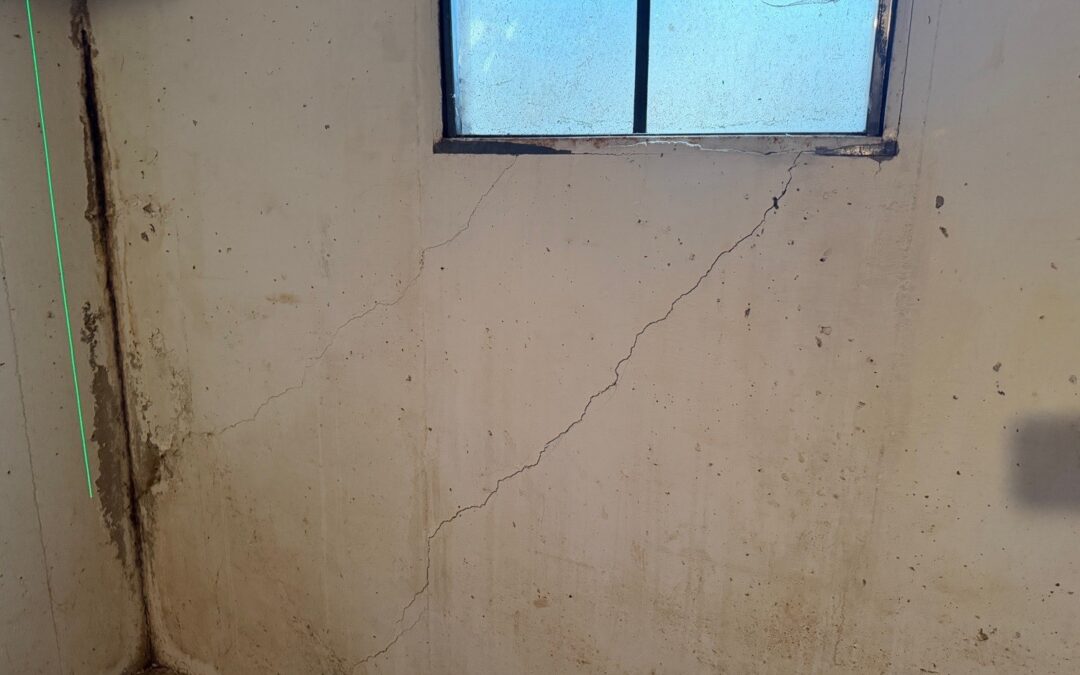
Late this summer, one of our inspectors inspected a 1950s ranch in north Leawood. It had a basement with concrete walls. Finished areas, storage and floor coverings hid parts of the basement, but cracks were visible in the walls we could see.
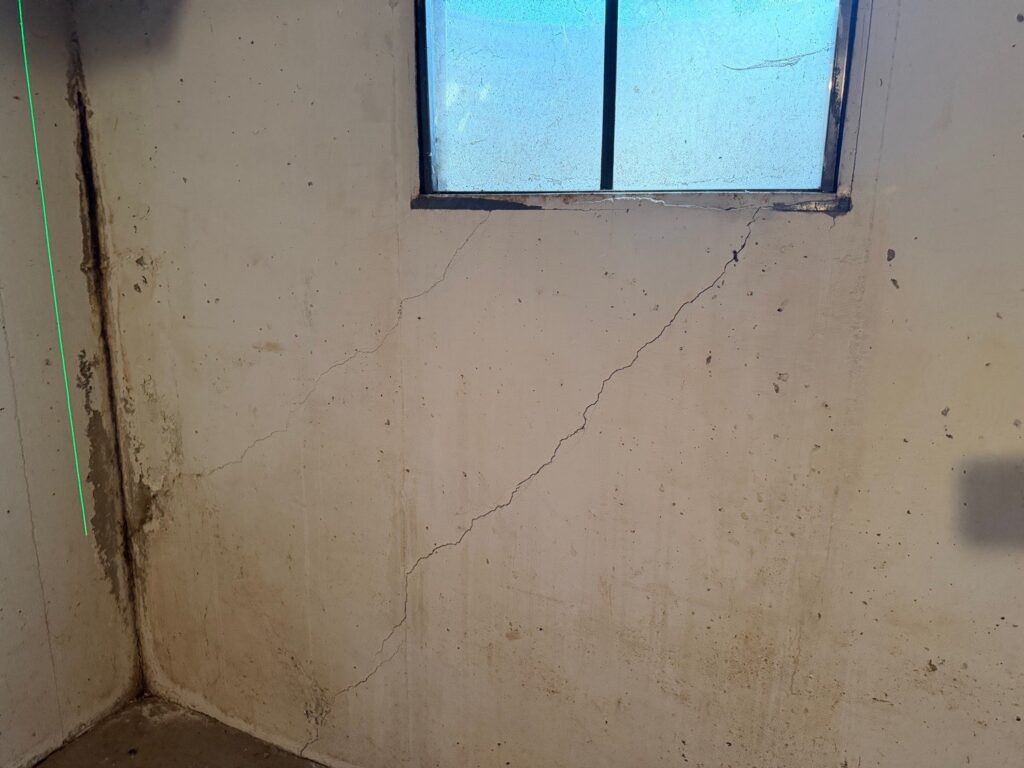
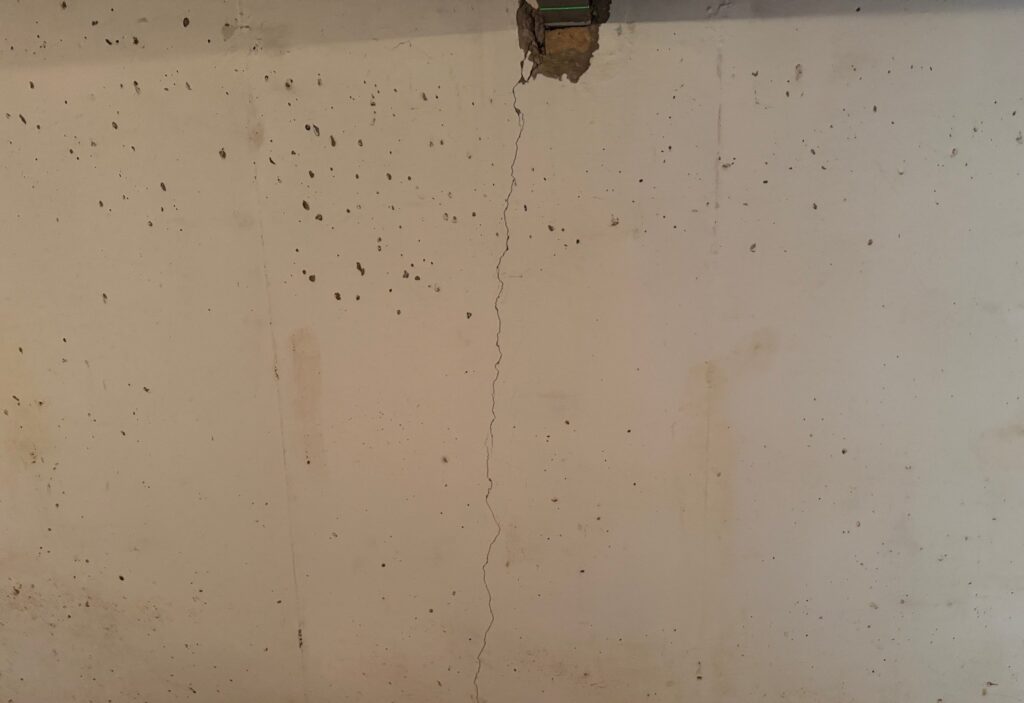
Diagonal cracks ran down from the corners of a basement window, and a separate vertical crack ran down a basement wall from the top. Our report listed foundation cracks and also found that two basement walls were leaning, one by more than an inch, and that the wall had shifted inward where a main beam rests on it. It recommended an evaluation by a qualified foundation contractor and a structural engineer. A sewer camera inspection was also done on this house. It found a low spot where water sits in the line, tree roots, and scale inside the cast-iron sections. The report doesn’t say what caused the low spot.
Key takeaways
- Cracks like these can be a sign the foundation has moved. Some are just shrinkage from when the concrete cured. A single visual inspection can’t tell you which, or whether it’s still moving.
- How a crack runs and how wide it is matter more than whether there is one. Cracks wider than about 1/8 inch, cracks wider at one end, and cracks where one side has shifted out of line are the ones to have looked at. In this house, the report recommended having the cracks evaluated.
- A foundation contractor can tell you what a repair would involve. A structural engineer gives an opinion without selling the repair. Get both before your inspection period ends if you can.
- Movement under a house can affect the sewer line, too. In Leawood, the line from the house to the public sewer main is the homeowner’s to maintain and repair.
What these cracks mean, in plain English
Basement walls hold back soil on one side and carry the house on top. Concrete is strong, but it doesn’t flex. It cracks as it shrinks while curing, and again if the soil shifts and the forces on the wall exceed what it can take (Concrete Foundations Association). The pattern of the cracks tells you something about what happened:
- Diagonal cracks from window or door corners. The corners of a window or door are stress points, so cracks often start there and run off at an angle (UC Davis). Many are harmless shrinkage cracks from when the concrete cured (NRMCA). Others come from the wall moving. Width, any leaking and whether one side has shifted help tell them apart. The first photo above shows this pattern.
- Vertical cracks. Vertical cracks, like the one here, are the most common kind in concrete basement walls, and many are shrinkage cracks. One that is wider at the top or bottom, or has one side out of line with the other, can point to settling or heaving (Concrete Foundations Association).
- Wide or uneven cracks. HomeAdvisor says cracks wider than 1/8 inch are cause for concern and worth calling in a structural engineer (HomeAdvisor).
What a visual inspection can’t tell you is when the movement happened. It may have happened decades ago and stopped, or it may still be going on. Either way, a crack is also a path for water. HomeAdvisor notes that even foundation cracks that aren’t structural give moisture a way in, which is one more reason to get them looked at.
Why foundations move on Kansas clay
A 2001 Kansas Geological Survey column calls expansive soils a more pervasive problem in Kansas than landslides. Expansive soil is clay that swells when it gets wet and shrinks when it dries out. It says soils that heave and shrink from season to season crack foundations, driveways and sidewalks (Kansas Geological Survey). That is a statewide description, not a soil test for any one lot, but a 1950s house like this one has been through some seventy years of those wet and dry seasons.
Water near the house makes the swelling worse, so the cheapest way to protect a foundation is to keep roof water away from it. Angi’s advice for keeping foundation costs down includes keeping an eye on drainage and making sure gutters and downspouts work (Angi). Our articles on clogged gutters in Kansas City and downspouts that drain at the foundation in Olathe cover those simple fixes.
Why foundation cracks can mean a sewer camera inspection, too
The sewer line leaves through the foundation and runs under the yard to the public main. When a foundation settles or moves, the ground around that pipe can move with it. That can leave a low spot where waste sits in the line, or crack or break the pipe. None of that can be seen from the basement. A camera run through the line can.
In Leawood, the bill for a problem in that line falls on the owner. Johnson County Wastewater says the service line from the home is private, and homeowners are responsible for its maintenance, repair and replacement, including its connection to the public main (Johnson County Wastewater). A sewer camera inspection is $200 when you add it to your home inspection.
What it typically costs
These are national ranges from cost guides, not Leawood quotes. The right repair depends on what is causing the cracks, so the contractor’s written estimate for this house is the number to use in a repair request.
| Item | Typical cost | Source |
|---|---|---|
| Structural engineer’s report | $340 to $780 | HomeAdvisor |
| Sealing foundation cracks | $250 to $800 | HomeAdvisor |
| Fixing foundation leaks | $2,000 to $7,000 | Angi |
| Foundation reinforcement | $1,000 to $5,000 | Angi |
| Piers to support a settling foundation | $1,000 to $3,000 per pier | HomeAdvisor |
| Foundation repair overall (national) | $2,225 to $8,133; about $5,175 on average | Angi |
Sealing a crack keeps water out, but it doesn’t address whatever moved the wall. That is why the evaluation comes first: a $250 crack repair and a multi-pier job can start with cracks that look much alike.
Next steps if your inspection finds foundation cracks
- Get a foundation contractor’s evaluation during your inspection period. Ask what likely caused the cracks, whether the wall needs repair or just sealing, and what it would cost.
- Add a structural engineer for a second opinion. HomeAdvisor points out that an engineer has no vested interest in selling you a repair, and puts a report at $340 to $780.
- Add a sewer camera inspection. If the foundation has moved, it’s worth knowing what the line under the yard looks like before you own it.
- Ask the seller what they know. Past repairs, receipts, warranties and any history of water in the basement all help a contractor or engineer read the cracks.
- Check where the roof water goes. Overflowing gutters and downspouts that end at the wall put water right against the foundation. Those are usually inexpensive fixes.
If you already own the home
Put a pencil mark and the date at each end of a crack, then look again every month or two. Angi suggests the same: mark cracks and watch for changes over a few months, and have a pro inspect right away if you suspect the foundation needs repair (Angi). Keep the gutters clean, keep downspouts carrying water well away from the walls, and call a foundation contractor if you see new cracks or water coming in.
What our home inspection covers
Our inspectors look at the visible foundation walls and floor, the framing they support, and the grading and drainage outside. We note cracks, bowing, past repairs and signs of water. In the first photo above, the green line is our inspector’s laser level, one of the tools we use to check a wall. Our inspection is visual: we can’t see behind finished walls or under floor coverings, and one visit can’t measure whether a crack is still moving. When we see signs of movement, we say so plainly and point you to the right specialist. If the house has already had foundation work, our article on buying a home with foundation repairs covers what to ask.
Frequently asked questions
Are cracks in a basement wall normal?
Some cracking is normal in concrete basement walls, and not every crack is a problem. The ones to have looked at are wider than about 1/8 inch, wider at one end than the other, leaking, or have one side sitting out of line with the other. Diagonal cracks off window corners are common and often just shrinkage, but they’re worth a look too. If you’re not sure, ask the inspector or a foundation contractor.
Can a home inspector tell if a foundation is still moving?
No. A visual inspection can show signs that a foundation may have moved, but not when, or whether it’s still moving. A foundation contractor or structural engineer can tell you more, and marking a crack and watching it over a few months shows whether it’s growing.
Should I call a foundation contractor or a structural engineer?
Both have a place. A contractor can tell you what a repair would involve and cost. An engineer gives an independent opinion on the cause and what’s needed, without selling the repair. For this Leawood home, our report recommended both.
Why would cracks in the basement lead to a sewer scope?
Because the sewer line runs out through the foundation and under the yard. Ground that moved enough to crack the walls may have moved the pipe, too, leaving a low spot or a break. A sewer camera inspection is the way to see it, and it’s $200 with your home inspection.
Who pays to fix the sewer line in Leawood?
The homeowner. Johnson County Wastewater says the service line is private, and the owner is responsible for maintaining, repairing and replacing it, including where it connects to the public main.
Buying a home in Leawood?
Our inspectors work in Leawood and across Johnson County. Bryan Standley, our owner, is a Certified Master Inspector® and trains every inspector on the team. Tylor Standley and Aiden Finlan are InterNACHI Certified Professional Inspectors, and office manager Laura Jarrell keeps scheduling simple. See our Leawood home inspection page for what else we find in Leawood homes, or meet the team.
Schedule your inspection online or call 816-343-9562. Home inspections start at $329, and Bundle & Save starts at $716. See our pricing for add-ons like sewer, radon and termite.
Related reading
- Home inspections in Leawood, KS
- Foundation repairs in Overland Park: what buyers should know
- Clogged gutters on a Kansas City, MO home
- Downspouts draining at the foundation in Olathe, KS
- Sewer camera inspections
Sources
- HomeAdvisor: How much does foundation repair cost? (updated June 2026)
- Angi: How much does foundation repair cost? (updated August 2026)
- Kansas Geological Survey: GeoRecord Vol. 7.3, From the Director (expansive soils) (2001)
- Concrete Foundations Association: TN-004, Cracking in foundation walls (PDF)
- NRMCA: CIP 7, Cracks in residential basement walls (PDF)
- UC Davis Geotechnical Photo Album: Settlement damage to buildings
- Johnson County Wastewater: Frequently asked questions (service line responsibility)
This article is based on a real Inspect KC inspection. Details that could identify the home or our clients have been left out. Both photos are from that home.
Recent Comments