
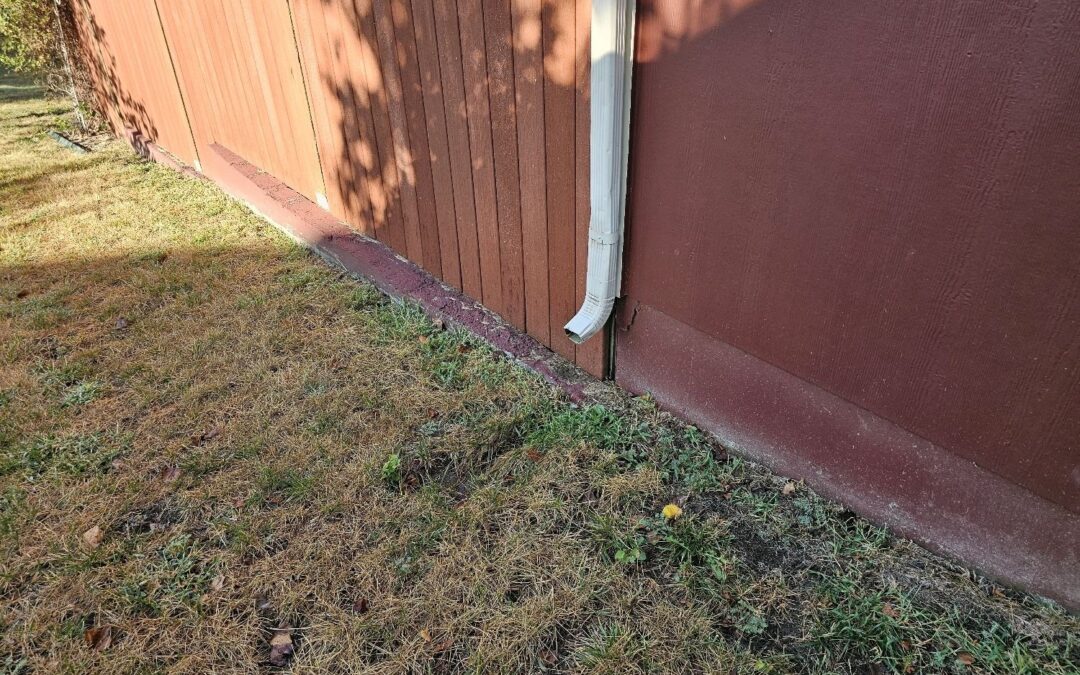
In September, one of our inspectors inspected a 1990s ranch in Olathe with a walk-out basement. Walking around the outside, the inspector found several downspouts ending right at the base of the house.
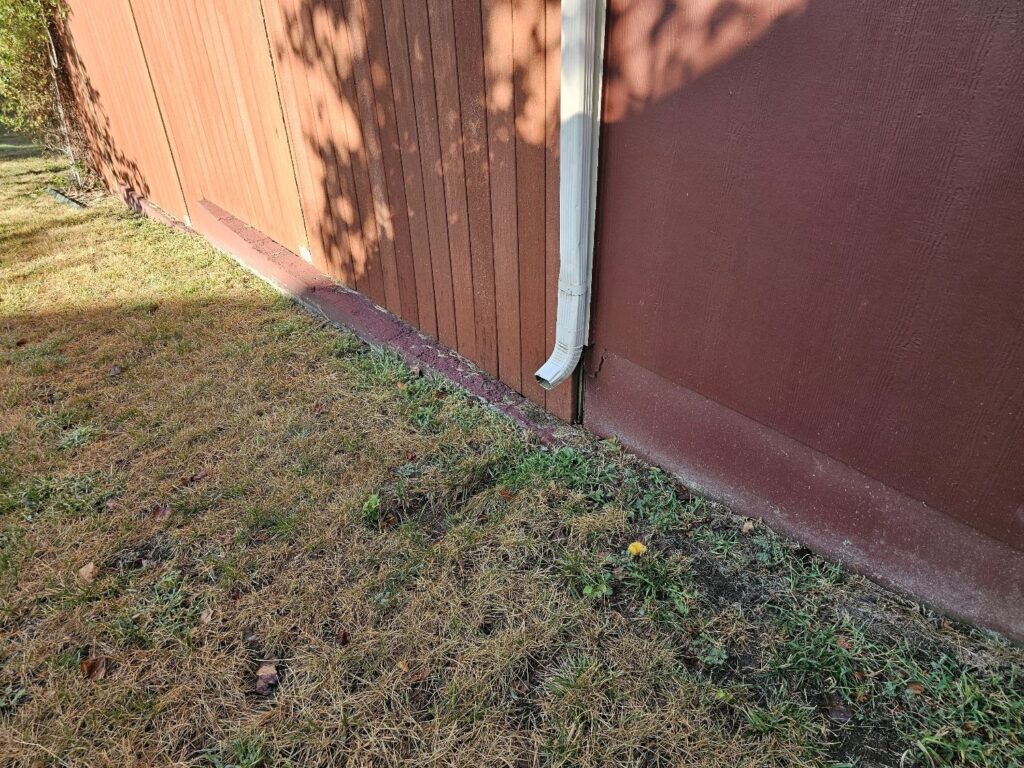
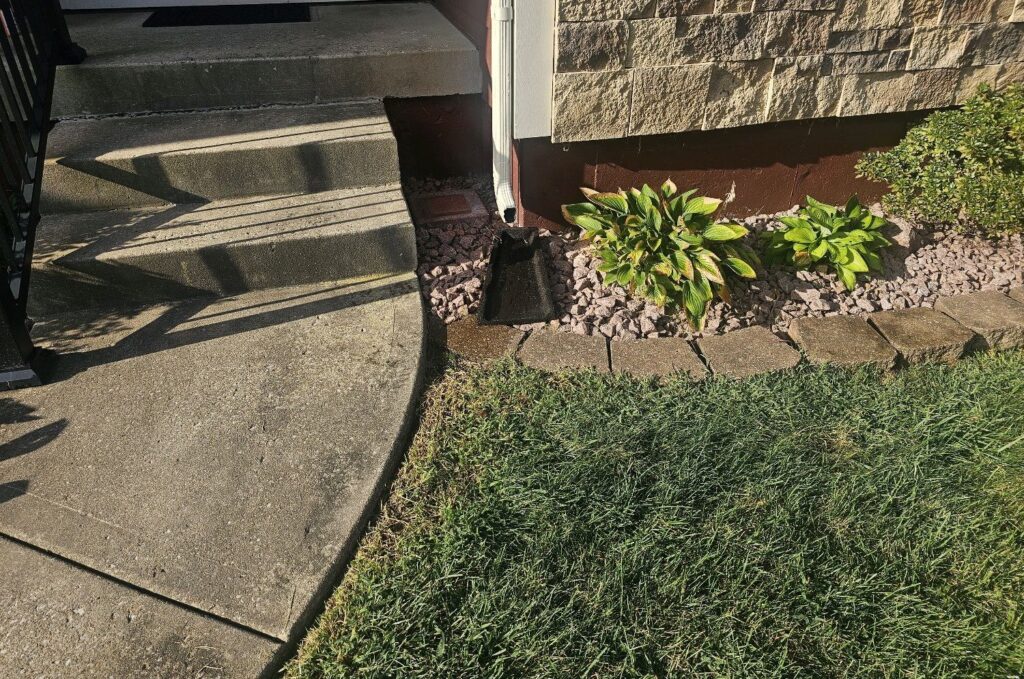
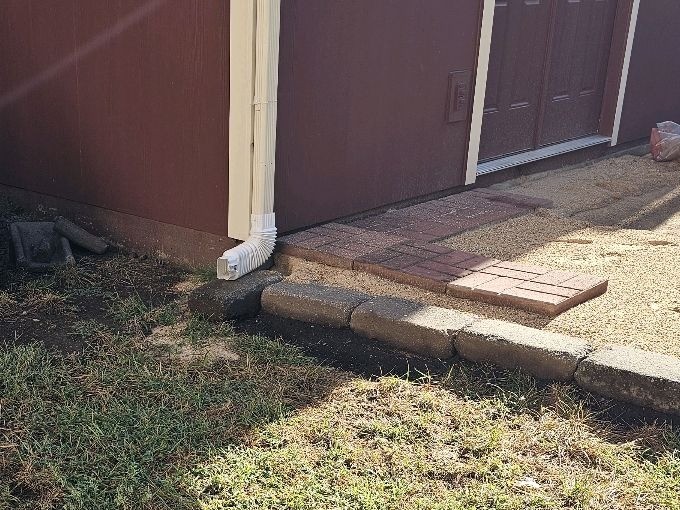
Some had no extension at all, so the water came straight down against the wall. Another emptied onto a short splash block in a rock bed beside an entry step. Our report noted downspouts emptying near the foundation and recommended a qualified gutter contractor correct them so roof water is carried away from the foundation. Inside, the report found no signs of water in the parts of the basement the inspector could reach. It’s one of the simplest items in a report to fix, and one of the more useful.
Key takeaways
- A downspout that ends at the wall drops the water from a whole section of roof right next to the foundation every time it rains.
- Local guidance says roof water should drain at least five feet from the house.
- The usual fix is a downspout extension. A basic one, installed, runs tens of dollars, not thousands.
- Olathe’s city code says roof drain discharges have to end at least 4 feet inside your property line (or 4 feet from the public right-of-way, whichever is closer), and can’t be tied into the city’s stormwater system without the City Engineer’s approval.
Why it matters, in plain English
Gutters collect the rain off the roof and send it down a handful of downspouts, so each downspout carries the water from a big piece of roof. Clean Water KC Metro estimates that each downspout on a house can drain about 12 gallons of water a minute during a one-inch rainfall (Clean Water KC Metro). When that downspout ends at the base of the wall, all of that water lands in one spot.
Our report explained what this can lead to. The water collects around the edge of the house and soaks the soil next to the foundation. Over time, that can lead to water getting into the basement, wear on the foundation and, in some cases, foundation movement. None of it happens in one storm. It’s the same spot getting soaked, year after year.
Why it matters more on Kansas clay
A 2001 Kansas Geological Survey column calls expansive soils a more pervasive problem in Kansas than landslides. Clay soils swell when they take on water and shrink as they dry, and that heave and shrink from season to season cracks foundations, driveways and sidewalks (Kansas Geological Survey). That’s a statewide picture, not a test of any Olathe lot. Still, a downspout that soaks the same patch of soil against the foundation all fall and spring is the opposite of what you want with clay. Our article on basement foundation cracks in Leawood shows what foundation movement can look like from inside the basement.
How far should downspouts drain?
Clean Water KC Metro says water should drain at least five feet away from the house, and that a splash block may help carry it farther (Clean Water KC Metro). Angi suggests 5 to 10 feet (Angi). Farther is better when the yard allows. For homes with basements, like this walk-out, University of Maryland Extension recommends 10 feet (University of Maryland Extension), and so does our gutters and grading guide. The ground should slope away from the house, too, so the water keeps moving once it lands.
Olathe also has a rule about where that water can end up. The city code says discharges from roof drains, sump pumps and French drains must end at least 4 feet inside the property line, or 4 feet from the public right-of-way, whichever is closer. They can’t be connected to the city’s stormwater system, which includes street curbs and gutters, without the City Engineer’s approval. Discharges that end closer, or in the right-of-way or on someone else’s property, are declared a public nuisance (Olathe Municipal Code 17.04.041). So the fix is to carry the water out into your own yard, not to the neighbor’s or onto the sidewalk.
What it typically costs
These are cost-guide estimates (Angi’s are national averages), not Olathe quotes. Most of the time, the fix is at the top of this table, not the bottom.
| Item | Typical cost | Source |
|---|---|---|
| Basic downspout extension, installed | Starts at about $33 to $39 per extension (basic 4-foot extension, installed; a pro’s minimum charge can make a one-off job cost more) | Homewyse |
| Splash pads, flexible elbows and similar add-ons | Mostly $5 to $50 | Angi |
| Downspout cleaning | $50 to $100 | Angi |
| Downspout installation (typical project) | $315 to $1,070; about $670 on average | Angi |
| Underground drain line for one downspout | $800 to $2,000 | Angi |
| Full underground gutter drainage system | $1,500 to $7,000; about $2,800 on average | Angi |
Above-ground extensions are the cheap fix. Underground lines cost more but keep a walkway, patio or mowing path clear. If you go underground, Angi notes the job may need a permit, and in Olathe the outlet still has to end at least 4 feet inside the property line and can’t connect to the city’s stormwater system unless the City Engineer approves it.
Next steps if your inspection finds downspouts at the foundation
- Treat it as a quick fix, not a red flag. You can ask the seller to add extensions, or plan to do it yourself after you move in.
- Read the rest of the report for signs water has already gotten in. Notes about water stains in the basement, damp spots or soil sloping toward the house tell you whether the downspouts have been causing trouble.
- Check the gutters, too. A downspout can only carry away what reaches it. Our article on clogged gutters explains why overflowing gutters put water in the same place.
- Extend each downspout at least five feet, and 10 feet where the yard allows on a house with a basement. Keep the outlet at least 4 feet inside your property line.
- If the report notes foundation cracks, take them seriously. Fixing the water is the first step, and a foundation contractor can tell you whether the cracks need more than that.
If you already own the home
Walk around the house during a heavy rain and watch where each downspout’s water goes. Extensions often get moved for mowing and can work loose, so check them after yard work and reattach any that have come off. A hinged or flexible extension is easier to move and put back (Virginia Cooperative Extension). Clean the gutters each fall, and make sure the soil next to the house still slopes away.
What our home inspection covers
Our inspectors walk the outside of the house and look at where each downspout ends, how the ground slopes and whether water has been pooling near the foundation. Inside, we look at the basement walls and floor for signs of water. Downspout notes are some of the least expensive items in a report to fix, and we keep them plain. Adding a sewer camera inspection covers the drain line from the house to the street.
Frequently asked questions
How far should a downspout drain from the house?
At least five feet, according to Clean Water KC Metro. Angi suggests 5 to 10 feet. For a house with a basement, University of Maryland Extension and our gutters and grading guide recommend 10 feet where the yard allows.
Is a splash block enough?
Sometimes. Clean Water KC Metro says a splash block may help carry water farther from the house. If the water is still ending up close to the wall, like the short splash block in this Olathe home, add an extension.
Can I bury my downspouts in Olathe?
Usually, yes. Angi puts one underground downspout line at $800 to $2,000 and notes some cities require a permit, so check with the city first. In Olathe, the outlet has to end at least 4 feet inside your property line (or 4 feet from the public right-of-way, whichever is closer), and it can’t be tied into the city’s stormwater system without the City Engineer’s approval.
Are downspouts at the foundation a reason not to buy a house?
No. It’s a common, low-cost fix. Check the rest of the report for signs water has already gotten into the basement, which is the part that can cost more.
How much does a downspout extension cost?
Homewyse estimates a basic 4-foot downspout extension starts at about $33 to $39 per extension, installed. A contractor’s minimum charge can add to a small job. Some homeowners put them on themselves with parts from a hardware store.
Buying a home in Olathe?
Our inspectors work in Olathe and across Johnson County. Bryan Standley, our owner, is a Certified Master Inspector® and trains every inspector on the team. Tylor Standley and Aiden Finlan are InterNACHI Certified Professional Inspectors, and office manager Laura Jarrell keeps scheduling simple. See our Olathe home inspection page for what else we find in Olathe homes, or meet the team.
Schedule your inspection online or call 816-343-9562. Home inspections start at $329, and Bundle & Save starts at $716. See our pricing for add-ons like sewer, radon and termite.
Related reading
- Home inspections in Olathe, KS
- Clogged gutters on a Kansas City, MO home
- Basement foundation cracks in Leawood, KS
- Our guide to gutters and grading
- Sewer camera inspections
Sources
- Clean Water KC Metro: Redirect downspouts
- Olathe Municipal Code 17.04.041 (roof drain and sump pump discharge)
- Homewyse: Cost to install a downspout extension (January 2026)
- Angi: Cost to install downspouts (updated September 2026)
- Angi: Cost to install underground gutter drainage (updated July 2026)
- Angi: How much does gutter cleaning cost? (updated October 2026)
- University of Maryland Extension: Downspout extension brief (PDF)
- Virginia Cooperative Extension: SPES-608 (PDF)
- Kansas Geological Survey: GeoRecord Vol. 7.3, From the Director (expansive soils) (2001)
This article is based on a real Inspect KC inspection. Details that could identify the home or our clients have been left out. All three photos are from that home.
Recent Comments