
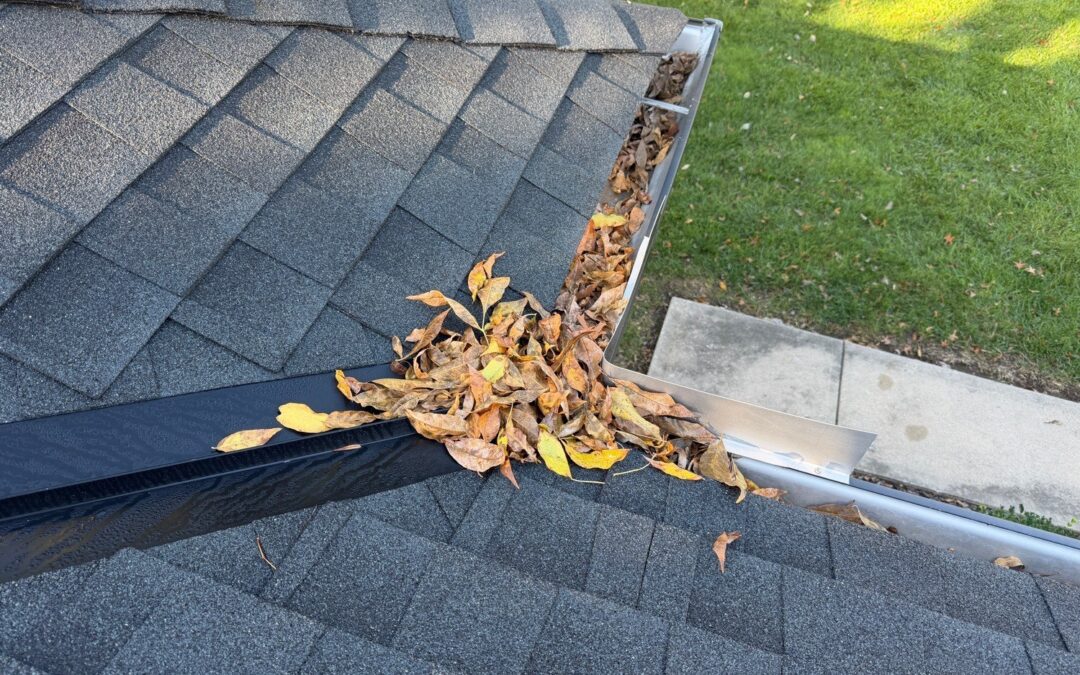
This October, one of our inspectors inspected a 1950s ranch in south Kansas City. It had a basement and a crawlspace. Up on the roof, the gutters were full of leaves.
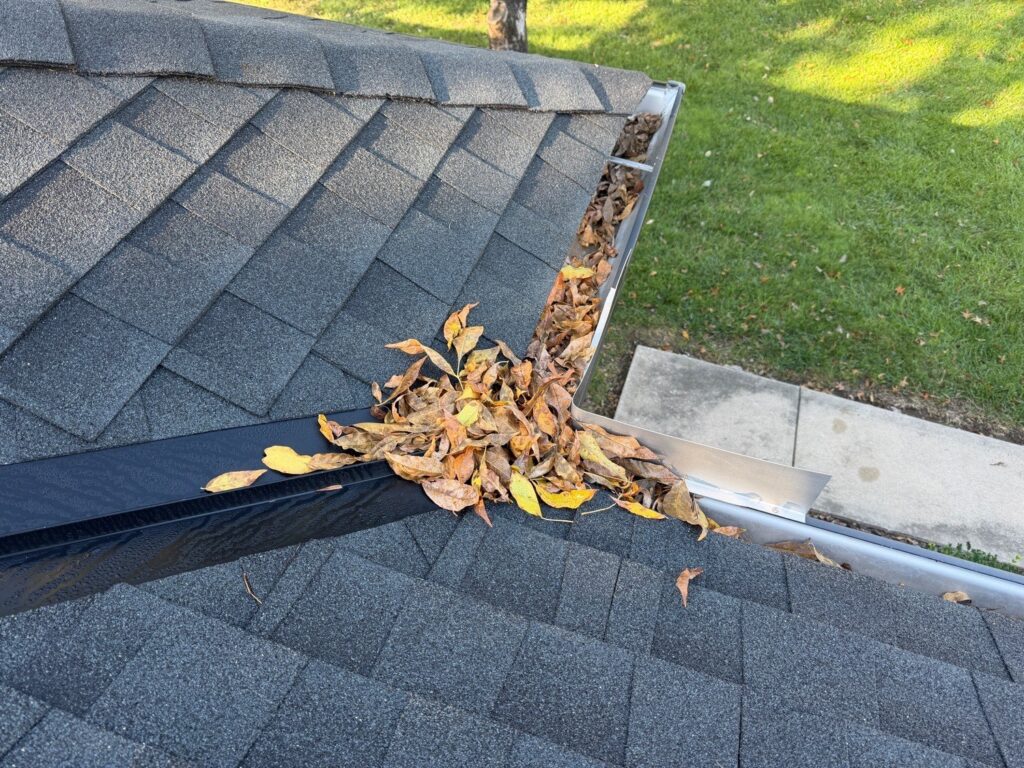
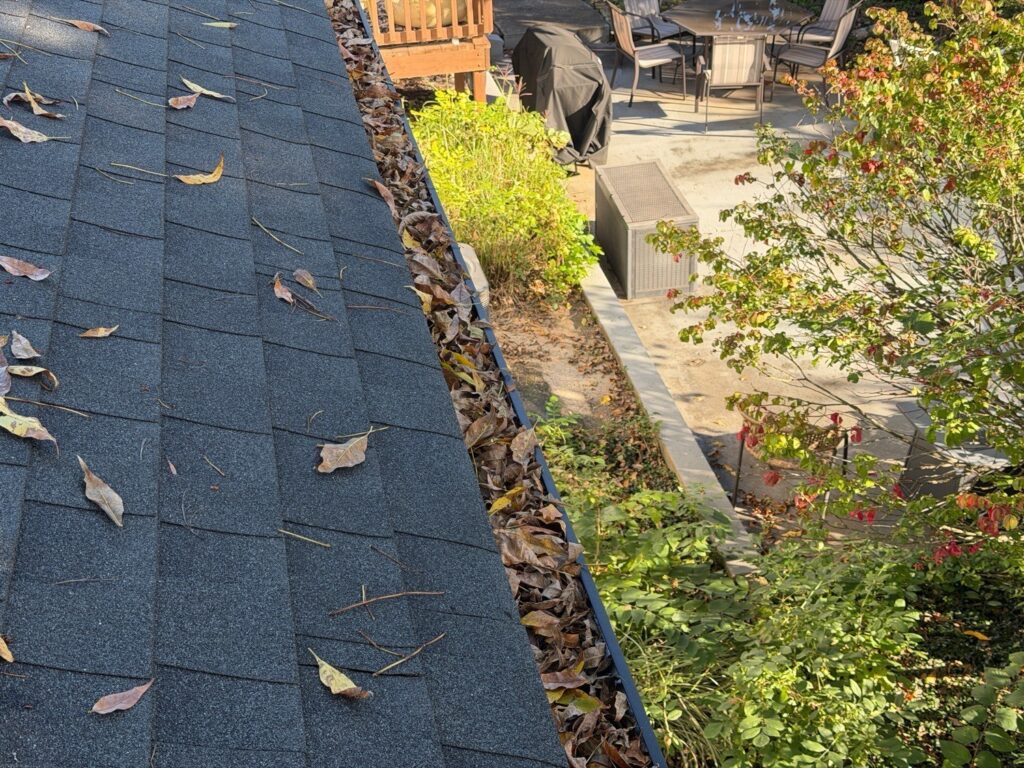
Leaves had piled up where two roof slopes meet, a long run of gutter along the roof edge was packed with leaves, and the gutter above the back patio was full too. Our report noted debris in the gutters and recommended cleaning by a qualified gutter contractor. This is normal fall maintenance, not a flaw in the house. It’s still worth knowing why it matters, because the fix is cheap and the water it controls is not.
Key takeaways
- Clogged gutters are a maintenance item, not a defect. Cleaning them is one of the least expensive jobs on a house.
- When gutters overflow, rain lands at the base of the house instead of going down the downspout. That is the one place you don’t want it.
- Plan to clean gutters at least once a year (our gutters guide suggests twice), with one cleaning in late fall after the leaves are down, and more often with big trees over the roof.
- Clean gutters only help if the downspouts carry the water away. KC Water says water should drain at least five feet from the house.
Why clogged gutters matter, in plain English
A gutter has one job: catch the water running off the roof and send it to the downspouts. Packed with leaves, it fills up and spills over the edge. That overflow soaks the fascia board the gutter is attached to and runs down the walls, and it pours onto the soil right next to the foundation. Over time, that can mean rotted trim and water in the basement or crawlspace. Angi lists water pooling around the foundation and basement flooding among the problems overflowing gutters can cause (Angi).
There’s more water involved than most people expect. KC Water’s stormwater guide says 1 inch of rain on a typical 1,000-square-foot roof produces more than 600 gallons of runoff (KC Water). With working gutters, that water leaves through a few downspouts. With clogged ones, it comes off the edge all along the house.
Why fall is gutter season in Kansas City
Kansas City has what its parks department calls a “mature” urban forest (KC Parks), and the city’s forestry plan found the most tree canopy in neighborhoods built from 1950 to 1980, and this house dates from the 1950s (KCMO Urban Forestry Master Plan). Homes with big trees overhead collect a lot of leaves in a short stretch of October and November. A gutter that was clean in summer can be full again a few weeks into fall, and spring brings seeds and blossoms. Angi says the average home needs gutter cleaning once or twice a year, and homes near oak trees may need it more often (Angi). The best time for the fall cleaning is after most of the leaves have dropped, so you aren’t doing it twice.
What it typically costs
These are national figures from Angi, not Kansas City quotes. Prices depend on the height of the house, the length of the gutters and how full they are.
| Item | Typical cost | Source |
|---|---|---|
| Gutter cleaning, national average | About $168; most homeowners pay $119 to $234 | Angi |
| Cleaning a one-story home | $145 to $250 | Angi |
| Cleaning a two-story home | $180 to $360 | Angi |
| Downspout cleaning | $50 to $100 | Angi |
| Gutter repair | $240 to $480 | Angi |
| Gutter guards | $6 to $8 per linear foot | Angi |
Angi also notes that neglected gutters can cost 10% to 50% more to clean, and that fall and spring are the busiest times of year, when prices can run higher. Some homeowners clean one-story gutters themselves from a ladder. If you do, work with someone holding the ladder.
Next steps if your inspection notes clogged gutters
- Keep it in proportion. It’s a small item. You can ask the seller to have the gutters cleaned, or plan to do it yourself after closing.
- Look for what the overflow may have already done. Check the report for notes on the fascia, the siding and the basement or crawlspace walls below the clogged sections. Soft trim or water stains are worth a closer look.
- Check where the downspouts drain. Clean gutters don’t help much if the downspout dumps the water at the wall. Our article on downspouts draining at the foundation covers the cheap fix.
- Make sure downspouts aren’t tied into the sewer. KC Water’s stormwater guide asks homeowners to disconnect any downspout that is connected to a sewer or disappears underground, and to send the water to a garden or grassy area instead. It notes that downspouts that disappear into the ground are most likely connected to the city sewer system.
- Consider gutter guards if trees hang over the roof. Angi puts them at $6 to $8 per linear foot. Ask the installer how the guards you’re considering get cleaned.
If you already own the home
Clean the gutters once the leaves are down in late fall, and again in spring. During a heavy rain, walk around the house: water spilling over a gutter edge, or a downspout that isn’t running, means there’s a clog. Keep the downspout ends carrying water at least five feet out from the house.
What our home inspection covers
When the roof is safe to walk, our inspectors walk it, so we see the gutters from above, the way the photos here show them. We note debris, loose or sagging sections, leaking seams and downspouts that end at the foundation, and then we look inside the basement or crawlspace for signs of water. Gutters are maintenance, so we note them plainly and keep the focus on the items that matter most. On older Kansas City homes, adding a sewer camera inspection covers the drain line out to the street.
Frequently asked questions
How often should gutters be cleaned in Kansas City?
At least once a year (our gutters guide suggests twice), with one cleaning in late fall after the leaves drop. Angi says the average home needs it once or twice a year, and homes near oak trees may need it more often.
Are clogged gutters a reason not to buy a house?
No. Clogged gutters are routine maintenance. What’s worth checking is whether the overflow has already caused damage, such as soft fascia boards or water in the basement or crawlspace.
Can clogged gutters cause water in the basement?
They can. When a gutter overflows, roof water lands right next to the foundation instead of going down the downspout. Angi lists water pooling around the foundation and basement flooding among the problems overflowing gutters can cause.
How far should downspouts drain from the house?
KC Water says water should drain at least five feet away from the house. If a downspout ends at the wall, an extension is usually an easy fix.
How much does gutter cleaning cost?
Angi puts the national average at about $168, with most homeowners paying $119 to $234. A two-story home costs more than a one-story home.
Buying a home in Kansas City, MO?
Our inspectors work across Kansas City, MO. Bryan Standley, our owner, is a Certified Master Inspector® and trains every inspector on the team. Tylor Standley and Aiden Finlan are InterNACHI Certified Professional Inspectors, and office manager Laura Jarrell keeps scheduling simple. See our Kansas City, MO home inspection page for what else we find in Kansas City homes, or meet the team.
Schedule your inspection online or call 816-343-9562. Home inspections start at $329, and Bundle & Save starts at $716. See our pricing for add-ons like sewer, radon and termite.
Related reading
- Home inspections in Kansas City, MO
- Downspouts draining at the foundation in Olathe, KS
- Basement foundation cracks in Leawood, KS
- Our guide to gutters and grading
- Sewer camera inspections
Sources
- Angi: How much does gutter cleaning cost? (updated October 2026)
- KC Water: Resident stormwater booklet (PDF)
- KC Parks: Forestry and conservation
- Kansas City, MO Urban Forestry Master Plan (PDF)
This article is based on a real Inspect KC inspection. Details that could identify the home or our clients have been left out. Both photos are from that home.
Recent Comments